
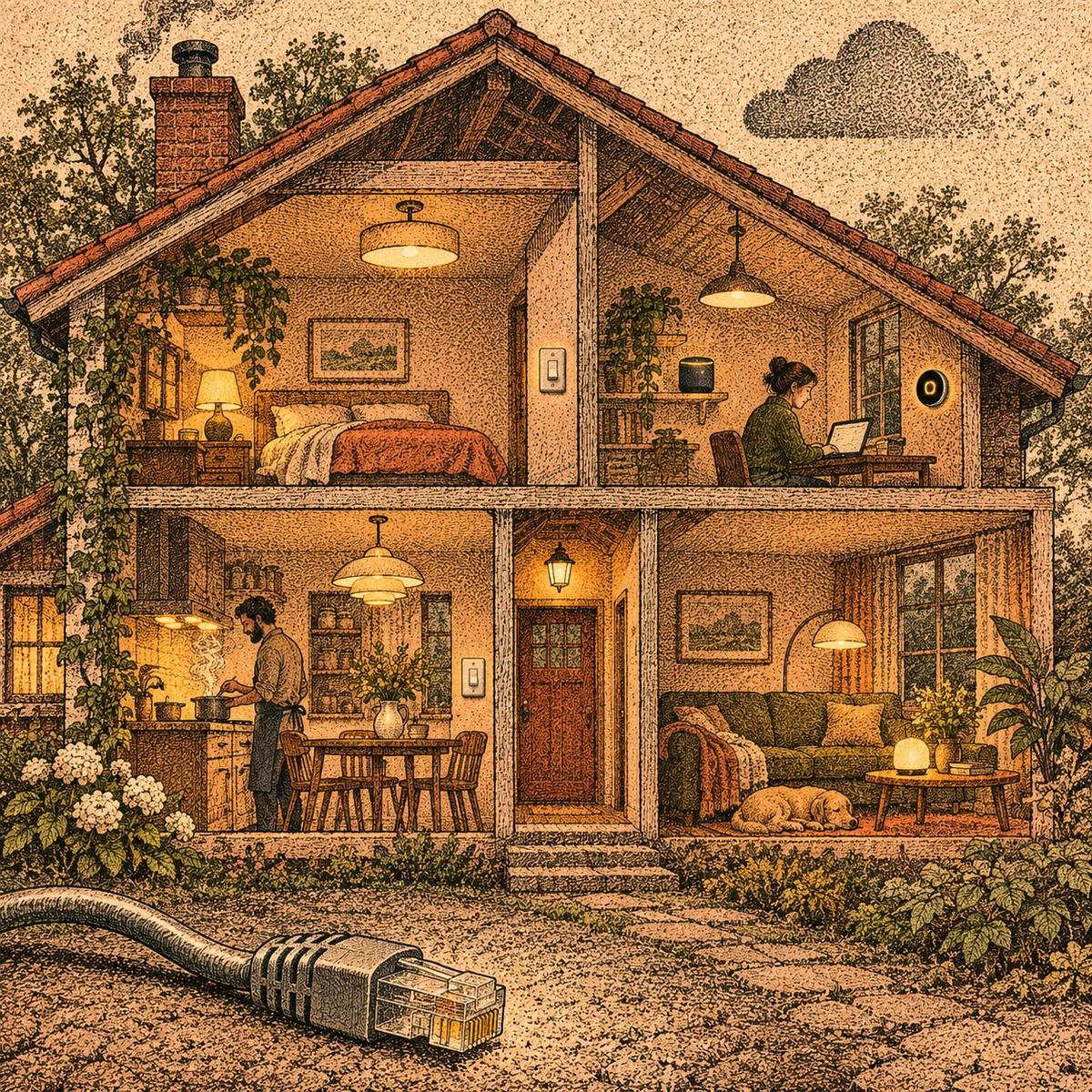
A light switch is an unusually good interface. You can find it in the dark. A visitor can use it without an explanation. It does not ask who you are.
Add a connected bulb, a voice assistant, and an automation app, and the light gains several new talents. It can change color at sunset or turn itself off when the room is empty. But if the original switch has to stay permanently on, something has also been lost. The household now has to remember the correct way to operate a light.
That is the question worth asking before the next smart-home purchase: does this add a useful option, or does it replace a dependable one with a dependency?
An internet outage is only one kind of outage
In an account of his home-automation setup, developer Spencer Kittleson describes a guiding constraint: essential functions should survive the loss of an internet connection. His system uses local hardware and software, with cloud services available as additional controls rather than the only controls.
It is a useful starting point, but “works offline” needs a more precise definition. A house can lose its connection to the outside world while its internal network keeps working. It can also lose its Wi-Fi, its automation hub, or the phone that holds the app. Those are different failures.
Imagine a lamp that you can switch on through an app while your broadband is down. That proves the command does not need to visit a distant server. It does not prove the lamp will respond if your router fails. And neither test tells you whether a guest can turn it on without borrowing your phone.
A resilient setup has layers. The physical control does the ordinary job. Local automation adds convenience. Remote access adds convenience from somewhere else. Each additional layer should be allowed to fail without taking the layers below it along.
Follow the command, not the logo
The box might promise compatibility with your preferred assistant. That tells you something about convenience, but not necessarily about the route between a request and its result.
For a purchase that matters, ask a specific question: when I press this button, where does the instruction go?
There are at least three possibilities. The button controls the device directly. It sends a message through equipment in your home. Or the message leaves your home, reaches a service, and comes back. A single product may use different routes for different features.
Home Assistant makes local control central to its approach, but its own description also explains that some integrations pull information from the cloud when no local option exists. Installing a locally hosted controller therefore does not make every connected device independent of its manufacturer. The particular integration still matters.
Ask for documentation about the exact feature you intend to use. “Local control” of brightness does not establish that a schedule is stored locally. An app that can display cached information is not necessarily able to issue a new command. A device that works after setup may still require an account to recover after a reset.
These distinctions sound fussy until the failure happens. Then they become the entire product.
Start with what the household cannot lose
It is tempting to plan around an inventory of gadgets: bulbs, plugs, sensors, speakers. A more useful inventory starts with activities.
Can someone get into the house? Adjust the temperature? Turn on the hallway light? Understand whether an appliance is running?
For each important activity, write down the ordinary control and the fallback. Keep the list short enough that another person can use it. If the fallback requires finding a password, installing an app, and waiting for an email, it is not much of a fallback at the moment it is needed.
A practical shopping checklist looks like this:
- Everyday operation: Can the basic function be controlled on the device, without a phone or account?
- Local operation: Which features continue when broadband is unavailable? Which also survive a failed router or hub?
- Recovery: What happens after a power interruption, battery replacement, or factory reset?
- Handover: Can a guest or another household member operate it without you?
- Support ending: Does the manual explain what remains usable if the online service is withdrawn?
A product does not have to pass every question to be worth buying. A decorative light is not a door lock. The point is to make the trade-off consciously rather than discover it while standing outside.
Test a convenience before trusting an essential
For nonessential equipment, a small, planned check can be more revealing than a feature list. Start with a lamp, keep its ordinary control available, and compare what the manual promises with what actually works when the internet connection is unavailable.
Do not begin by disconnecting medical equipment, alarms, access controls, or heating that someone depends on. Use manufacturer-approved checks for safety-critical systems, and involve a qualified installer where electrical work is required. An experiment should uncover a fragile dependency, not create a dangerous one.
Record the result in plain language: “Wall button works; phone control works on home Wi-Fi; voice command does not.” That is more useful to the household than a row of protocol names.
Repeat the check after a meaningful change, such as replacing a hub or moving an automation into a different app. A system can acquire new dependencies without acquiring any new hardware.
Convenience should be optional
None of this makes cloud services inherently pointless. Remote alerts, shared access, and voice control can be genuinely valuable. Running everything yourself also brings maintenance, updates, backups, and another small computer to look after.
The better question is not whether a device uses the internet. It is whether the internet is doing a job that justifies being in the way.
A well-designed smart home can be clever when everything is available and ordinary when it is not. The lights still turn on. The controls still make sense. Nobody needs to understand the architecture to make breakfast.
That is a quieter kind of intelligence, and a much more useful one.